

HISTORY MATTERS
I happened to be among those passing the intersection of Chestnut and Court streets when Portsmouth city workers uncovered the ancient coffins in the fall of 2003. We stood there peering down past a thin crust of asphalt to the earthen world below.
Later, archaeologists in faded blue jeans and colorful hardhats placed their bare hands against the rotted wooden caskets and hoisted them into the world of the living.
In an era before Facebook and smartphones, I rushed home to post the story on my website. Could this be the legendary Negro Burying Ground, hidden three centuries beneath the pavement, sliced apart by houses, and run through with sewer pipes? DNA evidence soon proved that the dead were indeed of African heritage.
We all knew this was a historic moment. In a city that touted its well-preserved cemeteries, Portsmouth, NH had conveniently misplaced, and then repurposed, the only graveyard dedicated to Black residents. Africans–some undoubtedly kidnapped, sold, renamed, impoverished, and marginalized–had been nearly written out of the New Hampshire story.
“The Burying Ground story is complex,” historian Valerie Cunningham told me. “It is not an easy story to deal with, not easy to talk about. Most people don’t want to deal with the real story.”
Let the learning begin
Indeed, the concepts of Yankee slavery and Northern racism can be a tough pill for some to swallow. New Englanders traditionally point with pride to famous white abolitionists, to the Underground Railroad, and to our opposition to slavery in the Civil War. A friend told me just the other day slavery in the North was “better” than slavery in the South.
“I think you are mistaken,” an out-of-state college professor told me about 30 years ago. We were leaning against the metal fence at Prescott Park watching the river rush toward the Atlantic Ocean. “I doubt there was any slavery going on in colonial Portsmouth,” he said.
But I knew better. I had been privileged to read an early draft of what would become the Portsmouth Black Heritage Trail by Valerie Cunningham. Like so many seaports, north and south, Portsmouth had been deeply involved in the slave trade almost from its inception in the early 1600s. Freed and enslaved Africans were key to the city’s 18th-century maritime economy. Prominent local merchants, even Christian ministers, were housed enslaved servants. In the 19th century, sleek Portsmouth-built ships were used in the illicit slave trade while the northern textile economy was tightly tied to southern cotton plantations.
Valerie’s pioneering study changed Portsmouth’s history forever. Her work continues to shine a light on the forgotten, we can even say “whitewashed,” local history. Black Portsmouth, her book with Mark Sammons, revolutionized the story of New Hampshire’s only seaport. Their research draws commercial tourists, scholars, and the merely curious to the city every year. Their research guides me toward a more honest, critical, and diverse history of this predominantly white New England city.
Getting the message right
Every day, visitors discover the African Burying Ground Memorial Park on Chestnut Street. But will we get the story right? What we find there is not always easy to process. It is a unique, flowing space of stone and sculpture. But exactly what happened here is not immediately apparent. The interpretive signs are brief, poignant, and polite. There are currently no artifacts of the city’s Black history on display, no dedicated museum exhibition to fill in the blanks.
“The fallout, as I see it,” Valerie says, “is that everybody who thinks they know a little about it is going to write their version. The mythology is just going to be multiplied, intensified, glorified, and distorted the way history is, especially Black history.”
As residents of Portsmouth and the Seacoast, we are all becoming stewards of local Black history. And it becomes our job, as best we can, to learn to teach visitors the unvarnished truth about the region. Here are three things we should remember about the African Burying Ground.
1: We knew it was there.
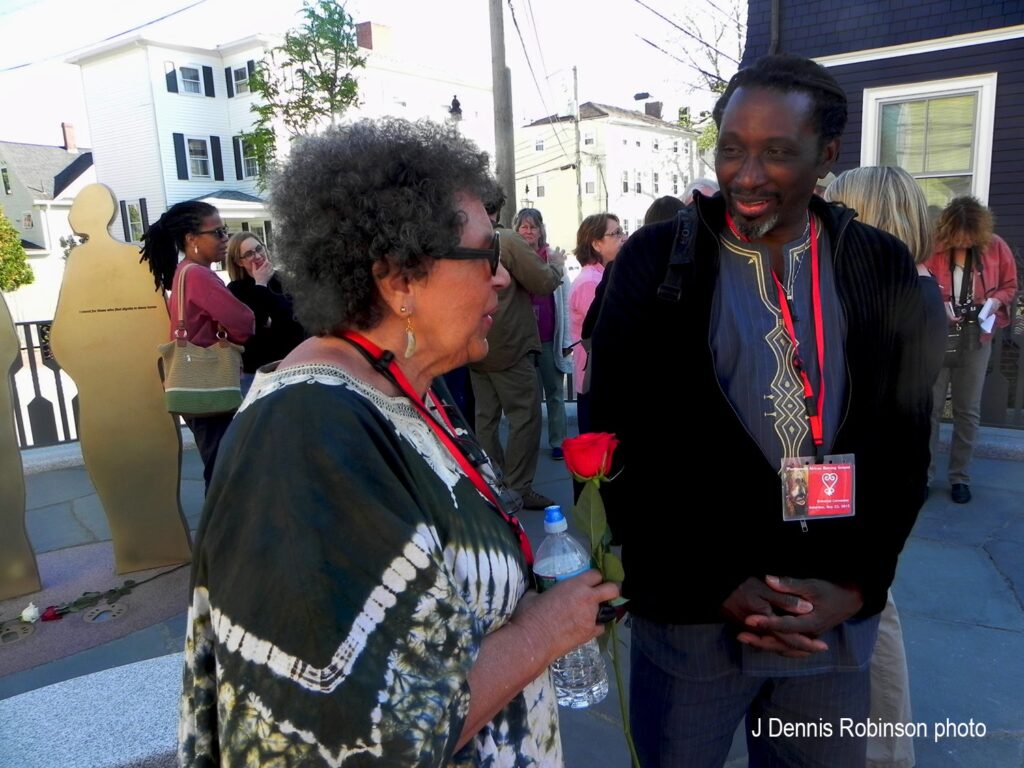
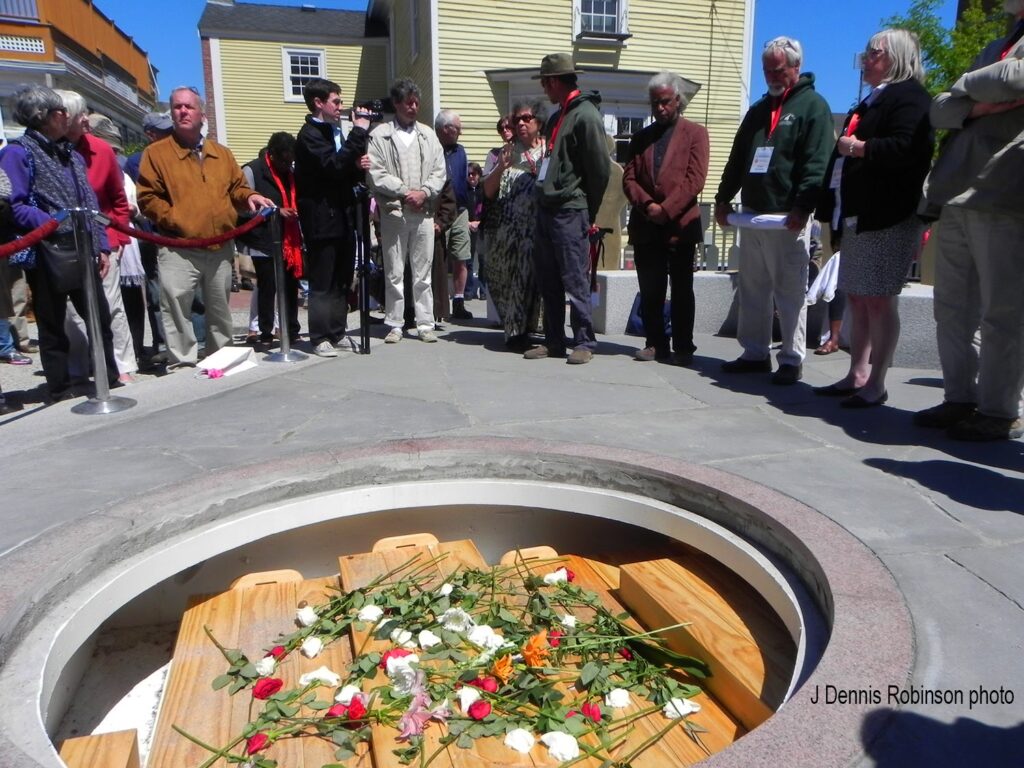
dedication of the African Burying Ground Memorial. J. Dennis Robinson photo.
The “discovery” of the burials in 2003 was no real surprise to historians. In fact, plaque #10 on the self-guided Portsmouth Black Heritage walking tour had been on view at the on Chestnut Street before the coffins appeared. The location of a “Negro Burying Ground” was first proposed some historians believe in 1705. Or perhaps it was already in use in the 17th century. The spot was labeled on a diagram of the area in the mid-1800s. Reports of human remains found in the vicinity during building construction were a matter of public record. With Valerie’s permission, I had posted her research on my website as early as 1997, six years before the “discovery” of the burials.
2: Don’t call it a slave cemetery
The truth is, we have no evidence yet that the people buried under the street were enslaved. It is fair to assume some were. Others may have been freed Africans. Still others may have been impoverished whites who were carried to the city’s potter’s field from the nearby almshouse or from Prison Lane, now Porter Street, the alley that runs along the Music Hall. The walking tour brochure refers to them as “the un-named, unrecorded dead.” To refer to the site as Portsmouth’s “slave cemetery,” as tempting as this may be for tourism, is to brand and diminish its occupants. We don’t routinely refer to the Whipple, Langdon, Wentworth, Moffatt, Warner, Stoodley, Stavers, Sherburne, Brewster, and other white families as “slave owners.” Yet they and many others were. What we do know is that the remains of those who were exhumed and returned to the earth were of African origin.
“If we think that the only thing that a Black person could be was a slave, then we can call it a slave cemetery,” Valerie adds.
3: We don’t know how big the cemetery is
The African Burying Ground Park is only the tip of the iceberg. The nine coffins ceremoniously placed under the circular burial vault lid represent only five percent of 200 bodies that may still lie in an undetermined area nearby. The graveyard may never have been clearly defined. Five other visible coffins, ones not immediately threatened by the city water and sewer lines, were left intact in 2003.
We cannot know how many burials were moved, found but unreported, or destroyed by expanding progress in the 19th and 20th centuries. Early newspaper accounts suggest human remains were discovered as far as a block away on Rogers Street toward the Middle School. And it is not unlikely that future redevelopment of the “Old Town by the Sea” will uncover more human remains in the heart of the city.
Only the beginning
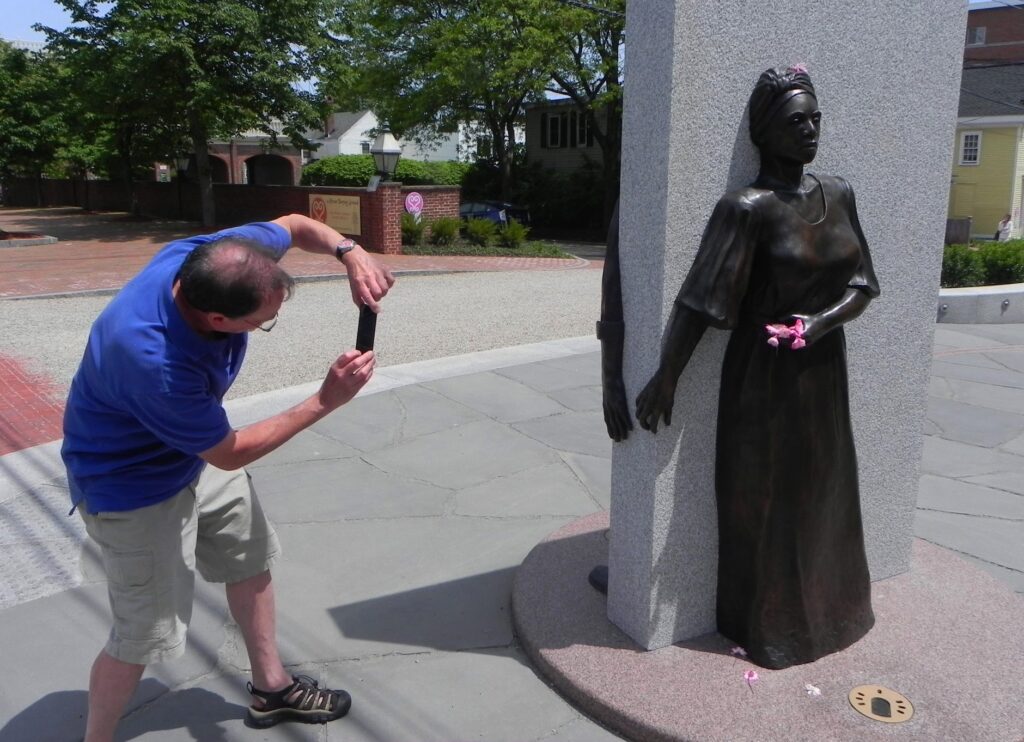
NH. Photo by J. Dennis Robinson.
The dedication of the memorial park was the overture, not the finale. “It isn’t over
Soon, I predict, the discovery of the coffins beneath the street will be as central to Portsmouth history as the visit by George Washington’s visit, Paul Revere inciting the raid on Fort William and Mary, the great downtown fires, and the Treaty of Portsmouth that ended the Russo-Japanese War.
What Portsmouth did, in creating the memorial, was wonderful, emotional, and right, but it didn’t fix the problem. We cannot repair the past. And, lacking a time machine, we can never fully understand the past.
The park is, at one level, simply a new place to sit, to ponder, and to talk. But that talk is inevitably informed by the surroundings, by the curvature of the stones and the anonymous sculptural figures there. I returned again and again. It is often the first place my friends want to see when they visit.
Our conversation drifts toward the topic of race, discrimination, and diversity. We talk about fairness and equality, about government, law, and activism. We begin wtih the unnamed people buried under the street, but soon, we are talking about what it means to be human.
“I’m not surprised by all the attention the park is getting,” Valerie concludes. “From the beginning, one of my mantras was—this is not just a local story,”
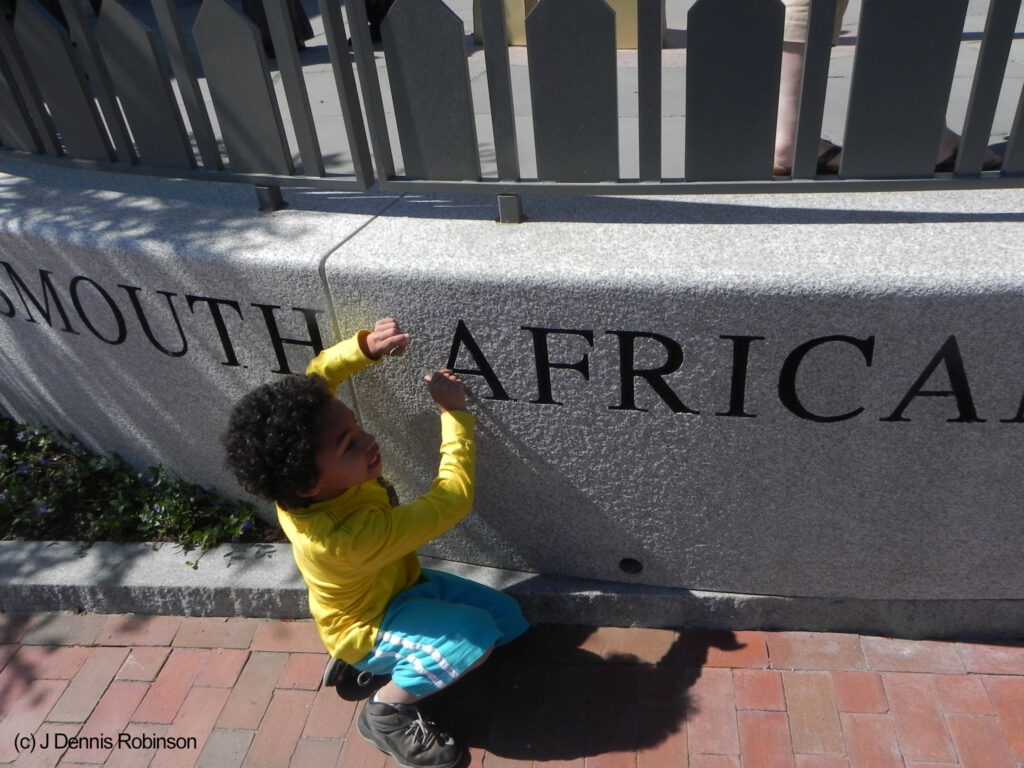
Ground Memorial on Court Street in Portsmouth, NH. J. Dennis Robinson photo.
Copyright © 2015 by J. Dennis Robinson, all rights, revised in 2025. All photos by the author. For more on this topic visit the NH Black Heritage Trail.
 A Few Quick Shark Tales